
Find Pennsylvania Residents Through Public Records
A useful Pennsylvania residents directory search starts with the detail already in hand. A name can lead to the Department of State's voter-status lookup or the Unified Judicial System docket search. A street address is better matched to a county assessment card or parcel map. An older address may need a library directory, newspaper, or archived deed. These sources do not form one shared roster. Each has its own custodian, search rules, and coverage, and a hit in one set does not prove that two people with the same name are the same person.
Keep the question narrow. Property records show taxable ownership, not every person in a home. A public docket lists a party to a case, not a confirmed current resident. Voter status reports registration, not ballot choice or every household member. Pennsylvania's county and municipal offices may keep the record that fills a gap left by a statewide portal. For a first pass, use a source that matches the clue, then compare a second independent record before treating it as a match.
- For an address, search the county assessment office or use the state parcel layer to find the parcel number.
- For a name, check the official voter-status form or a public UJS docket, using county and other known details to sort same-name results.
- For ownership history, follow the Recorder of Deeds grantor and grantee index, then request older books or images where web coverage ends.
- For a past household, look for a dated directory, census schedule, newspaper notice, or probate file held by a library, archive, or county office.
- If a needed record is not online, contact its custodian or make a focused Right-to-Know Law request for an existing record.
The Pennsylvania Offices Behind Resident Records
There is no central Pennsylvania office that keeps a complete list of residents. Begin with the county attached to the address, then identify the office for the record type. Assessment offices hold the authoritative tax roll; Recorders of Deeds hold land instruments; county elections offices maintain local voter records; and the Prothonotary or Clerk of Courts holds local case files. The State Archives courthouse guide lists county seats and helps route an address to its courthouse.
State offices fill some statewide needs. The Department of Health handles birth and death certificates from 1906 onward, while PHMC's State Archives keeps historic state and county material. The courts publish many docket sheets through UJS, but the county clerk still holds full files and certified copies. Local details vary across Pennsylvania's 67 counties, so a statewide map or index is a starting point, not a replacement for the office that certifies the record.
Pennsylvania State Archives
1681 North Sixth Street, Harrisburg, PA
Research room: Wednesday-Friday and the second Saturday, 9 a.m.-4 p.m.
Pennsylvania Vital Records Office
Department of Health, Division of Vital Records
Statewide birth and death records begin in 1906.
Department of State Elections
Voter questions: 1-877-VOTESPA.
County election offices hold local records and voter-file requests.
Current Pennsylvania Resident Rolls and Directories
The current resident directory picture is a group of partial records. Pennsylvania's assessment cards connect a named owner with a parcel and a tax mailing address. The voter lookup confirms a registration status, while a court docket shows a person named in a public case. State license and business systems can confirm a professional or entity affiliation. None of these records is designed to list everyone at an address, and their fields should not be combined into a claim the custodian did not make.
| Source | Who It Lists | Keeper | Access |
|---|---|---|---|
| Assessment card or parcel layer | Taxable owners and property fields | County assessment office | County search; state layer for discovery |
| Voter status | Registered elector status and polling details | Department of State and county elections office | Free person-led lookup |
| Public court docket | Named parties and public case events | Pennsylvania Unified Judicial System | Free public docket; full file at county court |
| Recorded deed index | Parties to land instruments | County Recorder of Deeds | County portal, counter, or archival route |
| License or business search | Public license or entity affiliation | Department of State | Free search; field coverage differs |
| Municipal permit file | Applicant, owner, or contractor named on a job | City, borough, or township | Local portal or records request |
Use the assessment card for a parcel question, the voter form for registration, and the docket for a court filing. The county office can explain an image cutoff, search syntax, or copy procedure that a statewide page does not show. A municipal permit may identify a project applicant or contractor, but it is not a list of occupants. Block-level association pages often show boundaries and meeting contacts, while member lists remain private.
| Source type | What it is suited to answer | How to check a result |
|---|---|---|
| Official county or state record | A defined question about ownership, registration, a filing, or a historical entry | Use the named custodian, its coverage notes, and a second record where needed |
| Commercial people-search category | A broad compiled lead that may combine public and purchased data | Do not treat it as authoritative; confirm with the primary record holder |
Older Pennsylvania Directories for Resident History
Printed Pennsylvania directories answer a different question from today's assessment and voter systems. Philadelphia's Free Library and City Archives hold city directories from 1785 through 1936, with gaps, while Cole's reverse directory runs from 1973-2007 on microfilm and 2009-2020 in print. The collections include name-to-address books, address-to-name books, telephone listings, and older street indexes. For other parts of Pennsylvania, local libraries and historical societies set the available years and formats. The city directory collections explain how to check a shelf or digitized run.
A directory entry is a dated clue, not a present-day address. It may list a name, occupation, street, spouse clue, or subscriber line, but it only represents people included by that publisher. A local historian can help bridge a renamed street or a missing year. The collection should be paired with deeds, census schedules, newspapers, or probate when tracing a household through time.
Route a Pennsylvania Search by County
Pennsylvania's 67 counties keep separate assessment, recorder, court, probate, and election systems. Even an office title can vary. Philadelphia uses a Department of Records for land documents, while other counties use a Recorder of Deeds. A county seat may also have shifted as the state grew, and an older record can sit in a parent county if it predates the current boundary. The State Archives courthouse guide helps match a present-day location to county history.
Confirm the county and municipality first, then locate the local custodian. For older property, a parcel number or legal description may work better than a current street number. The Archives' county and municipal guide explains which records remain local and which may be held in Harrisburg or on FamilySearch. Ask the office about portal coverage, counter access, and copy options when the online index ends.
Use Pennsylvania Parcel Fields With Care
The statewide PA Parcels layer helps locate a property across county lines. It exposes a parcel identifier, owner name, property address, city, ZIP, county, district, account, acreage, and map geometry. The feature does not provide a deed image, personal phone, utility subscriber, or household-member list. County assessment cards remain the source for tax fields, exemptions, assessed value, and local corrections.
These fields keep a Pennsylvania residents directory search anchored to the parcel instead of to a guessed household. Use the county name to open the local assessment site, then compare the situs address, which is where the parcel sits, with the mailing address, which receives tax mail. They may differ. A homestead exemption can support an owner-occupancy inference, but it is not proof that the owner lives there now.
The PA Parcels map layer view below shows how owner and parcel data attach to geography.
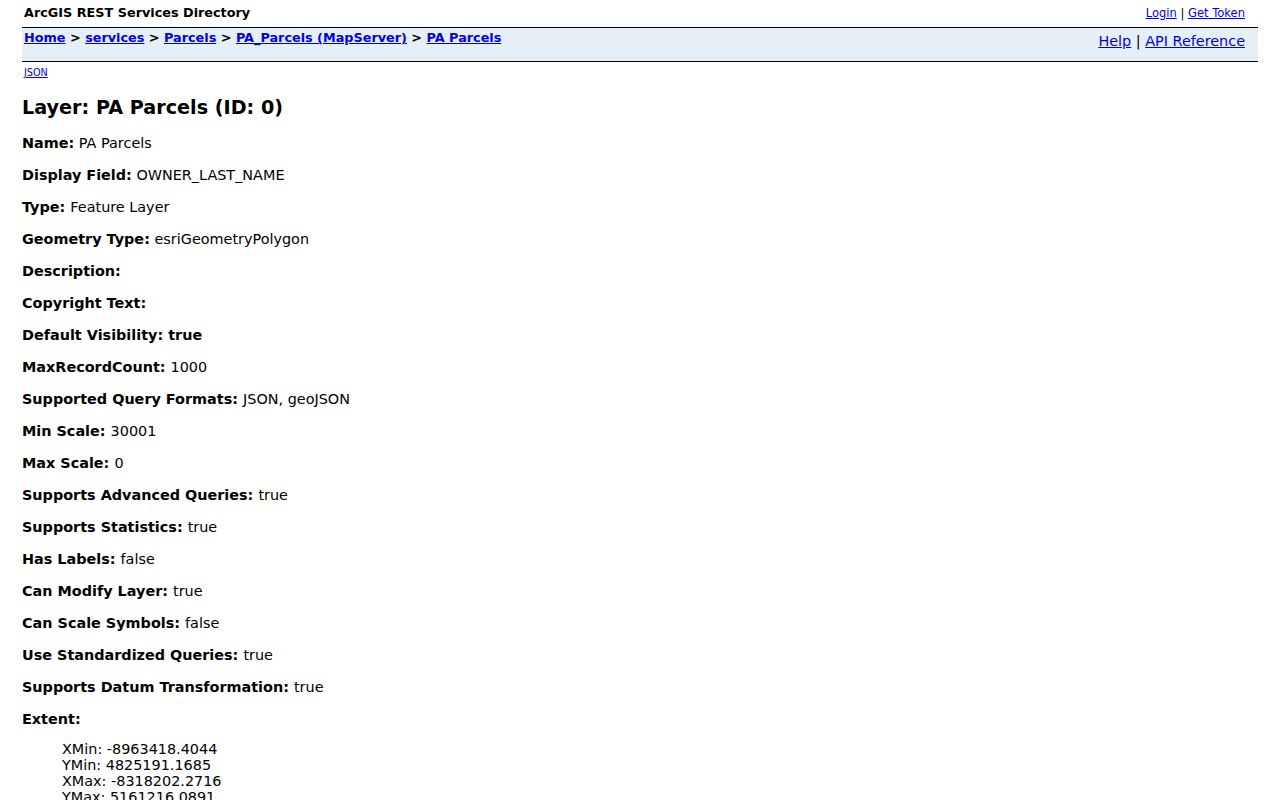
Use that view to find a county and parcel, then follow the street-address record workflow and confirm details with the local tax card and Recorder of Deeds.
- Owner: OWNER_NAME, OWNER_LAST_NAME, OWNER_FIRST_NAME, and NAME_EXT.
- Location: PROPERTY_ADDRESS_1, CITY, ZIP, COUNTY_NAME, and DISTRICT.
- Parcel and shape: PARCEL_ID, ACCOUNT, ACREAGE, ACRES, and map geometry.
- Limits: the statewide feature has no deed image, phone, utility-subscriber, voter, or household-member fields, and does not promise current assessed values.
- Parcel
- A mapped piece of land identified in a county tax system.
- Situs address
- The location of the property, distinct from the address for tax mail.
- Index
- A searchable guide to a record, which may not include the document image.
- Roll
- A list maintained for a defined purpose, such as property taxation or voter registration.
Check Pennsylvania Court Names by County
The Unified Judicial System public portal searches available docket sheets by participant name, docket number, and other case-specific identifiers. For a name search, select the county where a case may have been filed, enter the participant's last name and, when known, first name, then narrow by date, docket type, or status. A person can appear in a case outside the county where they live because the filing, property, or event may be elsewhere.
A result may show the docket number, court system, case caption, and a link to the docket sheet or case information. The sheet can list participants, filing events, charges or claims, scheduled events, costs, and disposition. It may not include pleadings or attachments. Juvenile, sealed, expunged, limited-access, or destroyed records may not appear. The UJS search help describes its fields, but the county clerk or prothonotary remains the route for a complete file, certified judgment, or archived case.
| Search field | Type | Required | Notes |
|---|---|---|---|
| Search By | Dropdown or radio | Yes | Participant Name, Docket Number, and court-specific alternatives. |
| County | Dropdown | Usually for a name search | Choose the filing county, which may differ from residence county. |
| Participant Last Name | Text | Recommended | Try punctuation or spelling variants. |
| Participant First Name | Text | Optional | Initials and abbreviations may vary. |
| Date of Birth | Date | Optional | mm/dd/yyyy; use only to separate same-name results. |
| Docket Type | Dropdown | Optional | Categories depend on court and may load dynamically. |
| Case Status | Dropdown | Optional | Active, closed, and other court-defined statuses. |
| Date Filed Start / End | Date pair | Optional | mm/dd/yyyy; narrow a long result set. |
| Docket Number | Text | Exact-number search | Format varies by court system, such as CP or MJ. |
| Search / Reset | Buttons | Action | Submit criteria or clear them. |
| Results filter | Control | No | Filter by county, status, or court and sort the grid. |
A typical public result and docket sheet include fields such as these:
- Result grid: docket number, court system, case caption, participant name, and the Docket Sheet or Case Information action.
- Case details: filing date, case type, party role, events, filings, scheduled events, charges or claims, costs, and disposition when public.
- Not always included: attachments, full pleadings, juvenile or sealed records, limited-access matters, expunged cases, and files removed under retention rules.
A same-name match needs another fact such as county, date, party role, or an address in an official filing. A court record can confirm that a person was named in a case; by itself it does not confirm current residence.
Pennsylvania Voter Status, Not a Resident Roll
The Department of State's voter status lookup is person-led. It can confirm whether a search subject appears registered and may provide polling details. If the form fails, try the county registration office or call 1-877-VOTESPA. A result can be missed after a move, name change, spelling difference, inactive status, or county mismatch. A non-match does not show that someone has left Pennsylvania.
The full SURE voter export is a separate regulated file. It costs $20 per county or statewide, is delivered electronically, and requires a use affirmation. It may be used only for elections, political activity, or law enforcement, and may not be posted on the Internet. The public fields can include a name, address, date of birth, party, status, polling place, and voting history; signatures, unique identifiers, driver's-license numbers, and SSN digits are restricted. This Pennsylvania residents directory does not reproduce voter lists.
The Department's voter-list request form spells out the affirmation and file terms. Voting history reports participation only, never a person's ballot choice.
Pennsylvania Vital Records Have Time Limits
The Department of Health's Division of Vital Records holds statewide birth and death certificates from 1906 onward. Before 1906, the trail is local: county courthouses, municipal registers, churches, and the State Archives may hold a record. Marriage and divorce files remain county-based rather than part of one live statewide certificate index. The right custodian depends on county and event date.
Birth records become public after 105 years, and death records after 50 years. Before a record matures, only eligible relatives or representatives can order a certificate with identification and required documents. A certificate costs $20, with an extra $10 service fee for online orders; mail requests use check or money order. Once death records are 50 years old, a non-certified genealogical copy may be available from the Archives, while certified copies still go through the Department of Health. The vital records pages list current methods and forms.
An index entry may supply a date and county, but a certificate is a separate record with its own eligibility rules. This distinction matters in family history: a public lead does not make every copy available to every requester.
Request Existing Pennsylvania Records Under RTKL
When a portal does not hold the document, the Pennsylvania Right-to-Know Law (RTKL), Act 3 of 2008, may be used to request an existing agency record. A requester must be a legal resident of the United States. Name the agency, describe the record rather than ask a question, and give a date span plus an address, parcel, or other locator. A request can ask to inspect a file or receive copies; filing itself is free.
Agencies generally have five business days to respond. A written extension is allowed in stated cases and should explain the reason and expected date. Under the Office of Open Records fee schedule, ordinary black-and-white copies are capped at 25 cents per page for the first 1,000 pages and 20 cents after. Search, retrieval, and review charges are not allowed; an estimate may need prepayment above $100. Use the standard RTKL form or the agency's own form, and appeal a denial or deemed denial to the Office of Open Records.
RTKL does not make an agency build a resident list or disclose exempt details. Direct a deed, voter, court-file, or municipal permit request to that record's custodian, not to a general statewide office.
Find Pennsylvania Heirs Through Probate
A probate file can connect a deceased property owner with an executor, heirs, and an estate address. Start with the Register of Wills or Orphans' Court in the county where the estate was filed. Read the docket and will for names, property references, and the person authorized to act; then check the Recorder for a later deed that transferred the property. Some filings may be sealed or otherwise restricted, and procedures for certified copies vary by county.
The FamilySearch Pennsylvania Probate collection covers 1683-1994, but county dates differ and a pre-formation case may be filed in the parent county. The State Archives' digitized county guide links to available finding aids and some FamilySearch material. If an online index ends, ask the county Register of Wills about its terminal, paper docket, archive, and copy fee. Probate is a documented estate connection, not proof of an heir's present address.
Pennsylvania Adoption Reunion Uses Consent
Adoption records do not belong in an open-name search. Pennsylvania's Adoption Information Registry (PAIR) provides medical and social history, with identifying information released through consent-based steps. An adoptee, adoptive parent, or birth relative may submit signed paper forms. A court that finalized an adoption may provide non-identifying information or arrange a search for consent, but no court or agency is required to locate a birth parent.
This route supports family reconnection while respecting the privacy choices of each person. The state registry explains which applicants may request information and what signatures or records must accompany an application. A directory hit, old address, or family name alone cannot open a confidential adoption file. Pennsylvania family research should follow the registry and court process rather than try to work around a protected record.
Pennsylvania's Lost 1890 Census Leaves a Gap
The 1890 federal census schedules for Pennsylvania were destroyed in the 1921 fire. For many households, that leaves an important gap between neighboring census years. City directories, church registers, county tax lists, probate files, and local newspapers can help bridge it. Philadelphia's Free Library and City Archives hold a long directory run from the late 18th century through 1936, while later reverse directories add address-to-name entries. Other regions depend on local library and historical society catalogs.
Directory years and census years do not record the same moment. A directory is often current for the year before its imprint, while a census is an enumeration-date snapshot. Compare addresses, occupations, spouses, and neighboring names, but keep each source's date clear. Pennsylvania's county boundaries also changed as new counties formed, so probate or deeds for an older household may sit in a parent county. This break is why a historical residents directory search often needs several dated steps instead of one final lookup.
Pennsylvania's 2026 Deed-Alert Warning
On February 4, 2026, the Pennsylvania Attorney General warned homeowners about property-ownership mailers that imitate official notices or charge inflated prices for a deed copy. The office recommended checking whether the county offers a deed-transaction alert and contacting the Recorder directly. A name or address in a letter is not proof that its sender is a government custodian.
For suspected title or deed fraud, keep the envelope and paperwork and contact the county Recorder and local police. The Attorney General's Bureau of Consumer Protection accepts reports at 1-800-441-2555. Its public warning outlines those steps. A county deed alert can flag a filing, but it does not replace checking the recorded instrument with the office that holds it.