
Pennsylvania Previous Residents by Record Era
Researching who lived at a Pennsylvania address takes more than one record type. Assessment cards identify current taxable owners; deeds trace title; directories or census schedules may place names at a home. The table shows major periods and Pennsylvania examples, not a statewide promise of online coverage.
| Source | Years Covered | Where Held | What It Shows |
|---|---|---|---|
| County assessment card | Current tax record; local update cycle | County assessment office | Taxable owner, parcel, situs and mailing address, sale data |
| County deeds | County-specific; Philadelphia 1683-1955 Archives, 1683-1973 historic images, 1974-present PhilaDox | Recorder, county archive, Philadelphia City Archives | Grantor/grantee, recording date, legal description, transfer |
| Philadelphia city directories | 1785-1936, with gaps | Free Library, City Archives, Historical Society of Pennsylvania | Listed name, address, calling, and some spouse clues |
| Cole's Cross Reference | 1973-2007 microfilm; 2009-2020 print | Free Library of Philadelphia | Street and number, listed occupant, phone, length of stay |
| Telephone and address books | White/yellow 1879-2007, gaps; address books 1927-1969 | Free Library Newspapers and Microfilm Center | Listed subscribers and address links |
| Federal census | 1790-1930 except 1890; 1950 released under 72-year rule | NARA, libraries, FamilySearch | Household on an enumeration date |
| Sanborn fire maps | City-specific editions, often 1880s-1950s | Library of Congress, libraries, archives | Building footprint, use, and street context |
| Philadelphia building permits | 1889-1986 Archives; 2006 and later Atlas/L&I; no index 1889-1905 | City Archives and city Atlas/L&I system | Work date, applicant, owner/contractor, selected plans |
| Probate | Pennsylvania collection 1683-1994; county-specific | Register of Wills and FamilySearch | Estate, executor, heirs, and address clues |
For recent transfers, begin with the county assessment card and deed index. Older household research needs directories, census, and local news. If a street number changed, check old street lists, plats, and the legal description. An owner is not always an occupant.
Trace Pennsylvania Owners Through Deeds
Deeds link owners, not everyone who lived in a home. Use the county assessment card to find the current taxable owner, parcel, and legal description, then start with that name in the Recorder's grantee index. Work backward through seller names, checking the county that held the land when each record was made.
- Write down the current parcel, situs address, municipality, owner name, and legal description from the assessment card.
- Search the Recorder's grantee index for the current owner and find the deed for the parcel.
- Read the deed for the seller, recording date, instrument number or book/page, parcel description, and prior reference.
- Search the seller as grantee to find the earlier transfer; repeat with each new seller and check estates or entities under their own names.
- When web coverage stops, note the deed-book range and ask for the counter terminal, microfilm, archive copy, or available FamilySearch image.
- Grantor / grantee
- The grantor transfers an interest; the grantee receives it.
- Chain of title
- The linked sequence of recorded transfers for a parcel.
- Legal description
- The land's formal description by lot, block, survey, or boundaries; it often remains useful when a street number changes.
Record each deed's grantor, grantee, document type, date, book/page or instrument number, municipality, transfer-tax reference, and image link if shown. Search every name form and recorded role, including spouses, estates, trustees, or companies, before treating a gap as the end.
Freeze a Pennsylvania Address Before Looking Back
Before searching for people who lived at a place, pin down which place the old records meant. Save the modern street number and spelling, parcel or UPI, municipality, county, map location, and legal description. Older sources may use a different street name, a rural route, a lot number, or a parent county. The address on an assessment card is a current label, while the deed's land description can bridge the change.
The county card can list owner, parcel, situs and mailing addresses, municipality, value, sale data, exemption, and sometimes a sketch. Mailing address helps locate an owner but does not show who lives at the parcel; a homestead exemption is evidence, not proof, of occupancy.
Pennsylvania county lines changed after the first counties were formed in 1682. When a family predates the modern county, check the State Archives' courthouse and county guide for the earlier jurisdiction. The FamilySearch probate collection also warns that records from before a county formed may sit with its parent county.
Find the Pennsylvania Recorder's Index Cutoff
There is no single online start year for deed searches across Pennsylvania. Each county sets its own index and image access, and some older books remain at a courthouse or archive even when recent deeds are searchable online. Ask the Recorder which years are indexed by name, which years have images, and whether the public can use a terminal in person. Search results and document copies may have different access rules or charges.
Philadelphia shows why the collections must be named precisely. PhilaDox searches deeds from 1974 to the present. Historic deed images cover 1683-1973 through a subscription search, and the City Archives separately holds deeds from 1683-1955. For earlier or non-digitized years in any county, use the recorder counter, county archives, microfilm, the State Archives' digitized-county guide, or FamilySearch's Pennsylvania probate collection when the relevant record set is available. The county office remains the first place to confirm its coverage.
Note index and image ranges separately. If no index is published, ask the records officer for a focused address, parcel, or date-range search under Pennsylvania's Right-to-Know request process.
Match Pennsylvania Owners to Directory Occupants
A deed names the parties to a transfer. It does not tell whether a buyer moved in, lived elsewhere, or held the land through an estate or company. A city directory gives another kind of evidence: a listed name tied to an address and often a calling. Compare the deed date with editions before and after the transfer, and keep “owner” and “listed occupant” as separate notes.
The Free Library's house-history guide recommends starting with the current title trail, then checking directories and maps. Ask a local Pennsylvania library or historical society which books cover the address. The Pennsylvania city directory collections explain Philadelphia's runs; other towns require their own catalog and a call to the holding desk.
Philadelphia's Cole's Cross Reference Directory orders streets and numbers for an address-first search. Its entries may show a name, phone, and length of stay; the Free Library's fact sheet lists 1973-2007 microfilm and 2009-2020 print. Address telephone books cover 1927-1969, while white and yellow pages run 1879-2007 with gaps. These are listed subscribers, not a full household count. A directory may reflect the prior year, so test a name against nearby issues, census, newspaper, or deed records.
Bridge Pennsylvania Street Names and County Shifts
Philadelphia's 1898 and 1910 directories include tables that convert old street names to new ones, and the City Archives maintains a historic street index. Search the prior name as well as the current one before treating a directory gap as a missing resident. An address may also change when a block is renumbered or an older township becomes part of a borough or city.
Outside Philadelphia, look for incorporation, annexation, and route-change records through the municipality, county archive, and local historical society. A deed's lot, block, or metes-and-bounds description can connect an old street label to a modern parcel. The same rule applies to county boundaries: a deed or probate file may sit in the parent county that held the address at the time.
The Philadelphia City Archives land-record and street-index entry point documents directories, historic deeds, permits, and street-name resources. It is a useful model for routing, though each Pennsylvania county controls its own records and search range.
The image shows the Philadelphia archive's land-record and historic street-index resource page, which can help connect an older street label to later records.
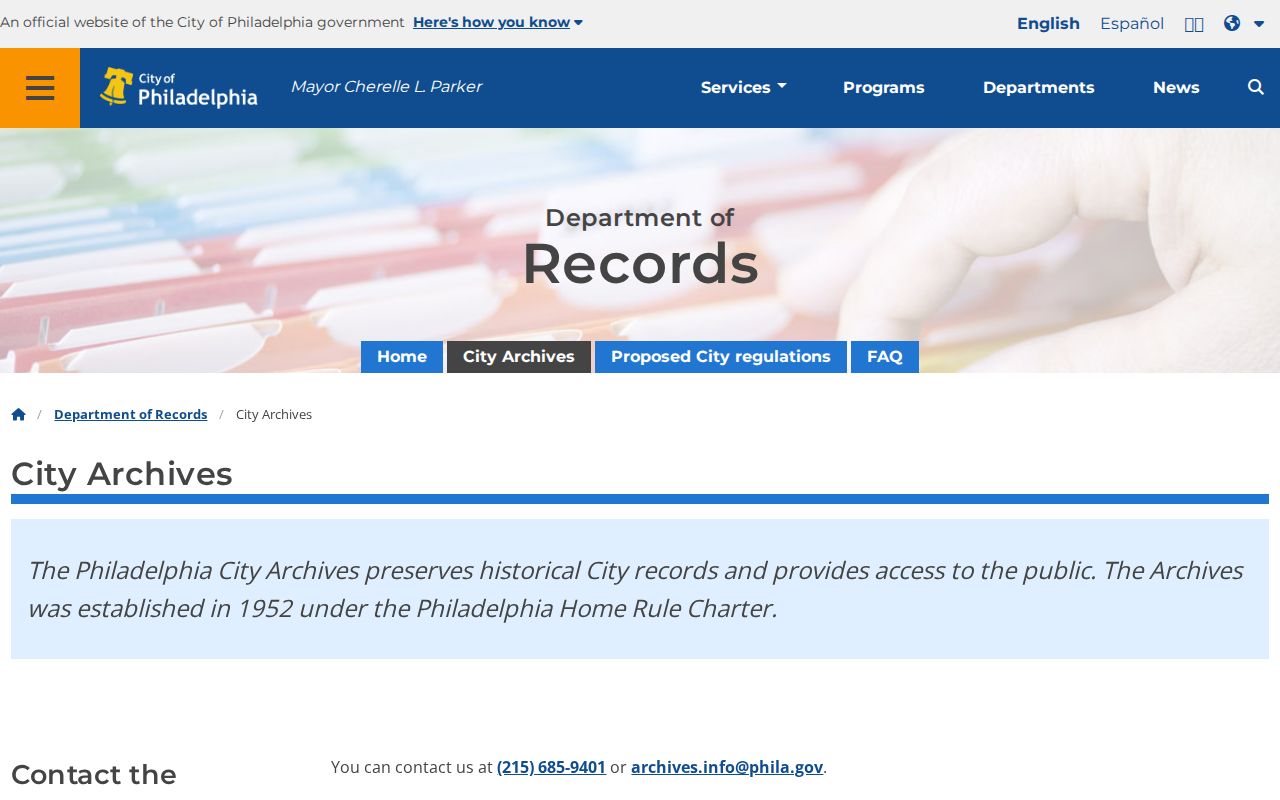
The holdings described there can help connect an older street label with the address used in later directories, maps, or deeds.
Pair Pennsylvania Directory and Census Years
Directories and census schedules fill different parts of a household timeline. A directory may be current for the prior year and show one listed resident and address. A census names a household on its enumeration date. Pennsylvania's federal census set survives for 1790-1930 except 1890; the 1950 census became public in 2022 under the 72-year rule. The 1890 schedules were destroyed in a 1921 fire, so researchers must bridge that decade with directories, churches, tax lists, newspapers, and probate.
- Choose a census year near the period of interest and note the enumeration address and household members.
- Compare the nearest directory issue, allowing for the directory's preceding-year convention and its gaps.
- Check a second directory or a deed date to see whether a move happened between the two snapshots.
- Use the local newspaper, church register, cemetery, or probate record to test a name change or death.
When the two sources disagree, preserve both readings and their dates. One may capture a move before the other, or the printed directory may omit a household member. Avoid treating a single census or directory as a continuous address history.
Pennsylvania Address History: Maps and Permits
Sanborn fire-insurance maps can date a building footprint and show its use, construction material, outbuildings, and nearby streets. They are not ownership records, but they can connect a structure to an address before a modern parcel number existed. Editions vary by town and often cover the late nineteenth century through the 1950s. The Library of Congress Sanborn search guide identifies a result's city, edition date, sheets, place names, notes, and available files.
The digitized 1910 Sanborn map for Everett, Bedford County is one Pennsylvania example. A map label or footprint can help tie a former street name to a deed description, but the county deed and assessment record remain the sources for recorded ownership.
Permits add a different date. Philadelphia's City Archives holds permits and selected plans from 1889-1986; its research notes no index for 1889-1905, and records from 2006 onward are in the city's Atlas/L&I system. A permit may name an applicant, owner, or contractor and describe work, but it is not a deed or proof that an applicant lived there. Other Pennsylvania municipalities keep their own permit files, often with different search options.
Pennsylvania Past Households: Directories and Obituaries
Previous residents can include owners and other people listed at the same address. Philadelphia's Free Library Social Science and History Department has an obituary/death-notice database covering 1860 to the present, and local Pennsylvania papers may carry death notices, wedding items, legal ads, or probate notices. Search the paper that served the town and check the relevant county library or historical society for an index or microfilm.
Cemetery offices, funeral homes, and church archives can add a burial date, lot, next of kin, or earlier community. Pennsylvania probate files may identify an executor or heir, but records created before a county formed may be held by its parent county. Read census and directory entries as dated household clues, then use the newspaper or estate file to test what happened next.
House history. Research into previous residents can support personal family or house history. Do not use names and addresses to follow, threaten, or harass a living person.